

Why farm equipment insurance needs a structured checklist
Farm equipment can represent a major investment and, in many operations, a direct link to productivity and income. Tractors, harvesters, irrigation systems, storage equipment and mobile plant may all be exposed to risks such as accidental damage, theft, fire, flood, vandalism, mechanical failure and interruption to normal farm work.
A checklist approach helps farmers work through the practical questions that affect cover: what equipment is owned, what it is worth, how it is used, where it operates, what risks are most relevant and what policy limits, exclusions and excesses apply. It also helps avoid relying on a generic policy that may not reflect the way a particular farm operates.
This guide is general information only. Farm equipment insurance terms vary between insurers and policies, so farmers should review the relevant policy wording and seek professional assistance where needed.
Step 1: Build a complete equipment inventory
The first step is to catalogue the machinery and equipment that may need to be insured. Modern farms often use a mix of traditional machinery and newer technology, so the inventory should cover more than just the largest assets.
Equipment to include in the inventory
- Tractors, harvesters, headers and other core production machinery.
- Irrigation systems, pumps and related water infrastructure.
- Hay balers, silos, barns and other harvest or storage equipment.
- ATVs, utility vehicles, trailers and other mobile farm equipment.
- Drones, GPS-guided equipment, sensors and precision agriculture tools.
- Robotic or automated systems, such as dairy robotics or greenhouse climate control equipment.
- Attachments, accessories and specialised implements that may not be obvious from a basic asset list.
For each item, record identifying details such as make, model, serial number, age, purchase date, purchase price, current estimated value, finance or lease details where relevant, and its role in day-to-day operations. If the equipment is leased or financed, the ownership and insurance requirements should also be checked.
Step 2: Assess value, replacement cost and operational importance
Valuing farm equipment is not only about the original purchase price. A useful insurance review considers current market value, replacement cost, depreciation, the availability of equivalent machinery and the operational impact if a key item is damaged or stolen.
Underinsurance can leave a farm with significant out-of-pocket costs after a loss. Over-insurance can also create unnecessary expense if sums insured are not realistic. The aim is to align insured values with the equipment's current role and likely replacement requirements, while understanding how the policy calculates claim payments.
Farmers reviewing broader farm cover may find a farm insurance calculator useful as an organisational starting point before discussing specific sums insured, limits and policy terms with an insurer or broker.
Questions to ask when valuing equipment
- What would it cost to repair or replace the item with a comparable unit?
- Has the equipment depreciated, or has its replacement cost changed?
- Is the item essential during planting, spraying, harvesting or livestock operations?
- Would downtime create additional costs, lost production or the need to hire replacement machinery?
- Does the policy use market value, agreed value, new-for-old replacement or another basis of settlement?
Step 3: Identify the risks each item faces
Farm machinery can be exposed to a wide range of risks depending on location, use, storage, age and technology. A useful insurance checklist considers both common and less obvious exposures.
| Risk area | Examples to consider | Why it matters |
|---|---|---|
| Accidental damage | Collisions, rollovers, impact damage and operator error | Heavy equipment is often used in demanding conditions and repairs can be costly. |
| Theft and vandalism | Stolen machinery, fuel theft, damaged pumps or tampered equipment | Mobile and high-value items may be attractive targets, especially if stored remotely. |
| Fire and weather events | Fire, flood, storm or other natural events | Damage can affect both equipment and the ability to continue farming operations. |
| Mechanical breakdown | Breakdown during critical seasonal work | Some policies may cover breakdown while others exclude wear, tear or poor maintenance. |
| Technology risks | Drone damage, sensor failure, interruption to smart equipment or cybersecurity concerns | Precision agriculture equipment may involve hardware, software and data dependencies. |
| Liability risks | Injury to visitors or damage to third-party property involving equipment | Liability cover may be needed alongside machinery protection. |
For a broader explanation of machinery-related cover, see this guide to how farm equipment insurance works.
Step 4: Match cover to key categories of equipment
Different types of equipment may need different policy considerations. A tractor used daily across multiple paddocks does not present the same risk profile as a fixed irrigation pump, a storage shed or a drone used for crop monitoring.
Tractors and harvesters
Tractors and harvesters are often central to productivity. When reviewing cover, consider accidental damage, theft, breakdown options, usage limits, where the equipment may be operated and whether attachments or implements are included. Check whether cover applies only on the farm or also while equipment is being transported or used elsewhere.
Irrigation systems and pumps
Irrigation systems and pumps may be critical during dry periods and can be vulnerable to damage, theft or vandalism. When assessing cover, consider the age and condition of the equipment, the cost of repair or replacement and the potential impact on crops or farm operations if the system cannot be used.
Hay, storage and post-harvest equipment
Hay balers, silos, barns and other storage assets help protect yield after harvest. Relevant risks may include fire, structural damage, collapse, pest-related issues where applicable under the policy, and damage to equipment used for baling, moving or storing produce.
Mobile equipment, trailers and utility vehicles
ATVs, utility vehicles and trailers support movement of people, tools and goods around a property. Their risks can include theft, accidental damage and liability issues. Check whether the policy treats these items as farm equipment, vehicles, trailers or another asset class.
Specialised and high-tech machinery
Autonomous equipment, drones, sensors, robotic milking systems and climate control systems may not fit neatly into standard machinery categories. Policies may need to account for their value, sensitivity, software or data dependency, and the practical effect of technical malfunction or interrupted operation.
Step 5: Consider supporting covers, not just machinery damage
Farm equipment insurance is often part of a broader farm insurance program. Damage to machinery is one issue; the financial and legal consequences that follow may require separate or additional cover.
Business interruption
If essential equipment fails or is damaged, the farm may face lost income or additional operating costs while repairs or replacement are arranged. Business interruption insurance is designed to respond to certain interruptions, subject to the policy terms. It may address operating expenses, temporary arrangements, payroll, taxes or loan payments where the policy provides that cover.
Liability insurance
Liability insurance can help address third-party claims involving property damage or bodily injury arising from farming operations or equipment use. It may respond to legal costs or settlements where a covered liability claim occurs. Farmers wanting to understand this area further can read more about policy documents and disclosure obligations.
Specialised endorsements or separate policies
Some equipment may require tailored cover or endorsements, particularly where it is high value, unusual, automated or used outside normal farm conditions. Discussing the equipment's function and risk profile with an insurer or a farm insurance broker can help clarify what policy options are available and what limitations apply.
Step 6: Read the policy details carefully
Policy details determine how cover works in practice. The most useful insurance checklist includes a close review of excesses, limits, exclusions, settlement methods and claims conditions.
Excesses and deductibles
An excess or deductible is the amount the insured contributes towards a claim before the insurer pays the covered balance. A higher excess may reduce premium costs but increases the amount payable by the farm if a claim occurs. A lower excess may reduce the immediate claim burden but can increase the premium. The appropriate balance depends on the farm's capacity to absorb smaller losses.
Exclusions
Exclusions explain what the policy does not cover. Common issues to check include wear and tear, gradual deterioration, damage from poor maintenance, mechanical breakdown caused by neglect, and events the policy specifically excludes. Understanding exclusions helps identify whether another policy, endorsement or risk management measure is needed.
Settlement method
Some policies may pay market value, while others may offer agreed value or new-for-old replacement in certain circumstances. New-for-old replacement can be important where maintaining current equipment capability matters, but the exact benefit depends on the policy wording, item age, limits and conditions.
Usage and location limits
Check where equipment is covered and how it may be used. A policy may treat on-farm use, road transport, contracting work, storage away from the property or use on another property differently. These details can affect whether a claim is covered.
Step 7: Keep records that support claims and reviews
Good records make policy reviews and claims easier. They also help show the condition, value and maintenance history of insured equipment.
- Keep invoices, purchase contracts and finance or lease documents.
- Record servicing, inspections, repairs and maintenance work.
- Photograph machinery, attachments and identifying plates or serial numbers.
- Store copies of valuations, policy schedules and correspondence with insurers.
- Update records when equipment is bought, sold, upgraded, modified or moved.
If damage or loss occurs, report the incident promptly and document the circumstances. Photos, repair quotes, police reports where relevant, maintenance records and a clear description of what happened may all assist the claims process. The insurer's claim requirements should be followed closely.
Step 8: Review cover as the farm changes
A farm equipment policy should not be treated as a set-and-forget document. Machinery values, operational needs and risk exposures can change as a farm expands, adopts new technology, changes production methods or replaces ageing equipment.
At a minimum, review cover annually and whenever significant changes occur. This may include buying new machinery, selling older equipment, adding drones or sensors, installing automated systems, changing storage arrangements, expanding operations or changing how equipment is used.
When comparing farm equipment insurance options or requesting quotes, use the inventory, valuations and risk notes you have prepared so the discussion is based on current and accurate information. You can also compare farm insurance options through the website's quote-start page.
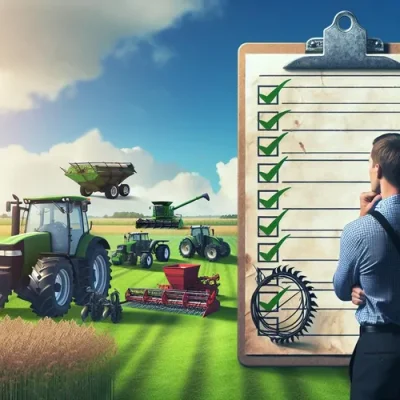
Farm equipment insurance checklist
- Create a full inventory of tractors, harvesters, pumps, trailers, storage equipment, drones, sensors and specialised systems.
- Record make, model, serial numbers, age, purchase date, purchase price and current estimated value.
- Assess replacement cost, depreciation and the operational importance of each item.
- Identify key risks, including damage, theft, fire, flood, vandalism, breakdown, liability and technology-related interruption.
- Check whether cover applies on-farm, during transport, off-site or when equipment is used for other work.
- Review supporting covers such as business interruption, liability and specialised endorsements.
- Read excesses, exclusions, limits and settlement methods carefully.
- Keep service records, inspection logs, photographs, invoices and repair documents.
- Report incidents promptly and provide clear supporting documentation for claims.
- Review the policy at least annually and whenever equipment, operations or technology change.
Final thoughts
Farm equipment insurance is a practical risk management tool for protecting machinery and supporting continuity when unexpected events occur. The most effective review starts with a detailed understanding of the equipment used on the farm, the value and role of each item, and the risks that could affect operations.
By maintaining accurate records, reading policy details carefully and reviewing cover as machinery and technology change, farmers can make more informed decisions about the insurance arrangements that support their agricultural business.